Learning & reflection
Use Islamic Quizzes to Find Questions Worth Studying
Turn an Islamic quiz result into a study question. Find why you missed it, open the cited source, read it in context and know when to ask a teacher.
Editorial writing date:
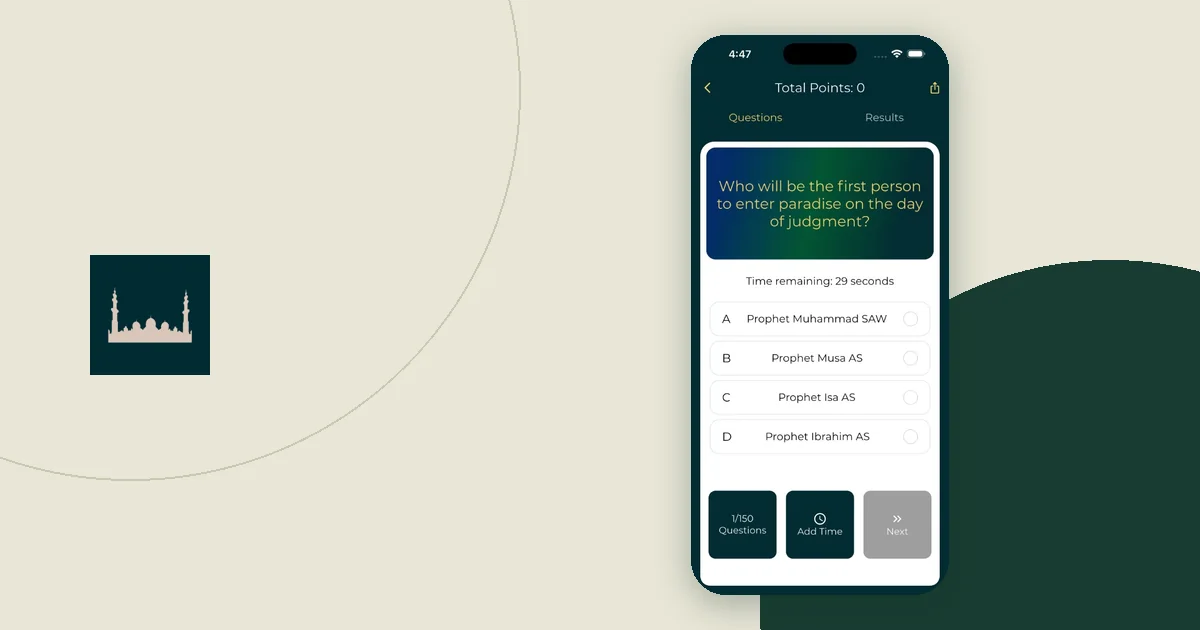
An Islamic quiz is most useful after you finish it. Take one question you missed, or guessed, and turn it into a study question. Find out why it was hard, open the source behind the answer, and read that source in context. A quiz score records one attempt at recall. It does not measure faith or prove that you know a subject.
Key Takeaways
- Save the exact quiz question, not just your score.
- Name the reason it was hard: recall, wording, context or missing evidence.
- Open the cited verse or hadith and check that it supports the answer.
- Take unclear or disputed points to a qualified teacher.
What a quiz result can and cannot tell you
A missed answer can mean several different things. You may have forgotten a fact. You may have misread a word like "not" or "first." You may have mixed up two similar names. Or the question itself may be unclear.
Each reason leads to a different study task, so it helps to name it:
| Why it was hard | What to do next |
|---|---|
| Recall — you knew it once but forgot | Read the source again and say the answer in your own words |
| Wording — you misread the question | Reread it slowly and note the word that tripped you |
| Context — you knew the answer but not why | Read the verses or narration around the cited passage |
| Missing evidence — no source is shown | Look for a reliable source, or record that support is missing |
A correct answer deserves a second look too. You may have recognized the option without understanding the passage behind it.
In Everyday Muslim, the quiz is called Islamic Trivia (see the Islamic quiz feature page), and it lets you review saved results. Where evidence is available, the answer's Sources and evidence panel shows supporting references, and Quran citations can open in the app's Quran reader. The feature page also says an older saved result may show that evidence is unavailable rather than attach an unrelated reference.
Write down the exact quiz question
A note such as "something about a prophet" is too vague to research. Copy enough to check the claim:
- Question: the exact wording, including words like "not" or "first"
- Answers: the one you chose and the expected one
- Reference: the verse, hadith or link the quiz gave
- Reason: recall, wording, context or missing evidence
- Next step: what to read or whom to ask
Leave out personal details. If you share a screenshot, crop out names and other people's results.
Open the source, not just the answer key
The Quran says, in Al-Isra 17:36: "Do not follow what you have no ˹sure˺ knowledge of." In quiz review, that means checking the source yourself instead of treating the answer key as its own proof.
For a Quran reference, read the cited verse and a few verses around it. For a hadith, check that the collection and number match the narration you are reading. A link can open without any problem and still point to a passage that does not support the claim. Read it before you rely on it.
A worked example: one missed question
Illustration only. This question was written to show the steps. It is not quoted from the app's question bank.
Say a quiz asks: "In Surah Maryam, which prophet is described as 'a man of truth and a prophet'?" Sara answers Isa. The expected answer is Ibrahim.
- She saves the question. She copies the wording and the reference: Maryam 19:41.
- She opens the verse. Maryam 19:41 reads, in Dr. Mustafa Khattab's translation: "And mention in the Book ˹O Prophet, the story of˺ Abraham. He was surely a man of truth and a prophet."
- She names the reason for her own answer. Earlier in the same surah, Maryam 19:30 describes Isa as destined "to be a prophet," and she mixed the two passages up. She also had not linked "Abraham" in the English translation with the name Ibrahim. Her own miss is a recall and naming gap.
- She reads on, and finds a problem with the question. Maryam 19:56 uses the same words for Idris, called Enoch in this translation: "He was surely a man of truth and a prophet." The Arabic, صِدِّيقٗا نَّبِيّٗا, uses the same words as 19:41. As written, the question has two possible answers, so it also has a wording problem.
- She reports it and writes a study question. She sends the exact question to support, noting that 19:41 and 19:56 both fit and suggesting it name the verse. Her study note reads: "Ibrahim (19:41) and Idris (19:56) are both called ṣiddīqan nabiyyā. What do the two accounts teach? Ask my teacher."
A second learner, Bilal, gets the same question right but has never read the passage. His score is better, yet he never noticed 19:56. His next step is the same: read the passage in context. Two learners, one score each, and very different study needs.
Five study questions to ask after any quiz
Use this list on any question you missed or guessed:
- Can I say why the expected answer is right without looking at the options?
- What exactly does the cited source say, in its own words?
- What do the verses or lines around it add?
- Is my difficulty about recall, wording, context or missing evidence?
- Is this a factual point I can check, or a question of interpretation for a teacher?
If you cannot answer a question yet, leave it open. Keep it on your list rather than writing a confident guess.
When evidence is missing or the question is unclear
If the quiz shows no evidence, do not attach an unrelated verse just to complete your note. Write "source not found" and decide whether you can find a reliable one or need help.
If a question seems unclear, copy the wording and say what is confusing when you report it to the app developer's listed contact address, support@umratech.com. Stick to what should be checked and why.
Some questions touch on details where scholars and schools differ. A multiple-choice format is too narrow for those. Take them to a qualified teacher.
Study before you retake the quiz
The Prophet ﷺ said, in Sahih al-Bukhari 5027, "The best among you (Muslims) are those who learn the Qur'an and teach it." When a quiz question is about a Quran passage, let the follow-up be reading that passage, not just another attempt at the test.
Give the follow-up a place in your week. The weekly Islamic learning routine shows how to turn one quiz question into one week of study. To find a passage again later, use the Quran bookmarks and notes guide. The Quran translation and context guide explains why a translated verse is only the start of understanding it.
If the question was about a prophet, the Prophets Tree in Everyday Muslim offers a visual overview. Its own page says a diagram simplifies a larger subject, so go back to the Quran and reliable scholarship for details.
Keep the score in proportion
A high score does not make someone more faithful, more sincere or qualified to give religious guidance. A low score does not mean the opposite. The guide to worship goals without scores explains how to keep any number in its place.
A good quiz session ends with a source you understand better or a clear question to study next.