
Everyday Muslim · Prophets Tree
Explore the Prophets Tree, then follow your curiosity.
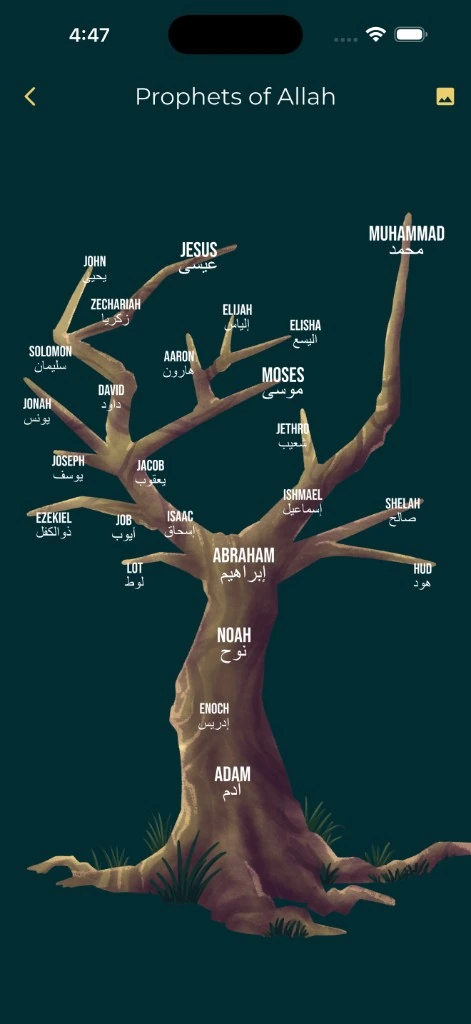
Get a visual starting point for learning about the prophets in Islam. Open the Prophets Tree in Everyday Muslim and explore the details available for each entry.
- Visual overview
- Prophet details
- Connected learning tools
Reference
The 25 prophets named in the Quran
The table below lists 25 prophets and messengers by name, in an order commonly used when they are taught, from Adam to Muhammad. Each row gives one verse where the Quran names that prophet, so you can open it and read the passage yourself.
The Quran also states that not every messenger is named in it: “We already sent messengers before you. We have told you the stories of some of them, while others We have not” (Quran 40:78; see also 4:164).
Belief in the messengers is part of the statement of faith in Quran 2:285, which includes the words “We make no distinction between any of His messengers.”
| # | Arabic | Name | Named in |
|---|---|---|---|
| 1 | آدم | Adam | Quran 2:31 |
| 2 | إدريس | Idris (Enoch) | Quran 19:56 |
| 3 | نوح | Nuh (Noah) | Quran 6:84 |
| 4 | هود | Hud | Quran 11:50 |
| 5 | صالح | Salih | Quran 7:73 |
| 6 | إبراهيم | Ibrahim (Abraham) | Quran 6:83 |
| 7 | لوط | Lut (Lot) | Quran 6:86 |
| 8 | إسماعيل | Ismail (Ishmael) | Quran 6:86 |
| 9 | إسحاق | Ishaq (Isaac) | Quran 6:84 |
| 10 | يعقوب | Yaqub (Jacob) | Quran 6:84 |
| 11 | يوسف | Yusuf (Joseph) | Quran 6:84 |
| 12 | أيوب | Ayyub (Job) | Quran 6:84 |
| 13 | شعيب | Shuayb | Quran 7:85 |
| 14 | موسى | Musa (Moses) | Quran 6:84 |
| 15 | هارون | Harun (Aaron) | Quran 6:84 |
| 16 | ذو الكفل | Dhul-Kifl | Quran 21:85 |
| 17 | داود | Dawud (David) | Quran 6:84 |
| 18 | سليمان | Sulayman (Solomon) | Quran 6:84 |
| 19 | إلياس | Ilyas (Elias) | Quran 6:85 |
| 20 | اليسع | Al-Yasa (Elisha) | Quran 6:86 |
| 21 | يونس | Yunus (Jonah) | Quran 6:86 |
| 22 | زكريا | Zakariyya (Zechariah) | Quran 6:85 |
| 23 | يحيى | Yahya (John) | Quran 6:85 |
| 24 | عيسى | Isa (Jesus) | Quran 6:85 |
| 25 | محمد | Muhammad | Quran 48:29 |
Quran 6:83–86 names eighteen of these figures in one passage, and 6:89 then describes them as “the ones to whom We gave the Scripture, wisdom, and prophethood.”
Quran 19:56 describes Idris as “a man of truth and a prophet,” and 21:85 mentions him alongside Ismail and Dhul-Kifl.
The Quran describes some of these figures as messengers. For example, 48:29 begins “Muhammad is the Messenger of Allah.”
The order shown is a common teaching order, not a ruling. For questions about the status of a particular figure, consult a qualified scholar.
Begin with an overview you can explore
Open the Prophets Tree from the app’s tools. Move through its visual layout and select an entry to read the available information. The app also includes a setting for changing the tree view.
A visual arrangement can make a large subject easier to approach. Take one entry at a time and keep a note of the questions you want to investigate further.
Use the tree as an introduction
A diagram necessarily simplifies a much larger subject. Do not treat a visual connection, ordering or summary as an exhaustive historical record or proof of a detail by itself.
When a detail matters to your study, return to the Quran and reliable scholarship. This page introduces the learning tool rather than presenting a new timeline or a definitive genealogy.
Keep the Quran nearby as you learn
Use the Quran reader to explore a passage connected to the topic you are studying. Translation and tafsir tools can help you read with more context rather than stopping at a short summary.
Reading a passage and its explanation takes longer than browsing a diagram, but it gives your questions somewhere useful to go.
Explore the Quran reader and tafsir toolsReturn with a small question to answer
Try a short trivia session or choose another Islam 101 lesson after studying. Use the result to notice what you remember and what you want to revisit, without treating a score as a complete assessment.
Explore Islamic TriviaA few useful answers
Before you begin.
Where is the Prophets Tree?
Open the Prophets Tree from Everyday Muslim’s tools to explore the visual view and available details.
Is the tree a complete historical genealogy?
It is a learning overview. A diagram simplifies the subject and should not be treated as proof of every historical relationship or detail.
Can I read Quran alongside it?
Yes. The app includes Quran reading, translation and tafsir tools to support further study.
Is this an online interactive tree?
This page explains the feature in the mobile app. Open Everyday Muslim to explore its interactive view.
How many prophets are named in the Quran?
This table lists 25 prophets and messengers named in the Quran, each with a verse you can open. The Quran also says there were messengers whose stories it does not tell (Quran 40:78 and 4:164).
Which verse names the most prophets together?
Quran 6:83–86 names eighteen of them, including Ibrahim, Nuh, Musa, Isa and Yunus. Quran 6:89 then refers to them as those given the Scripture, wisdom and prophethood.
Does the Quran mention prophets who are not named?
Yes. Quran 40:78 says Allah sent messengers before the Prophet Muhammad, told him the stories of some of them, and did not tell others. Quran 4:164 makes a similar statement.
Sources & further reading
- Quran 2:31 (Quran.com)
- Quran 2:285 (Quran.com)
- Quran 4:164 (Quran.com)
- Quran 6:83 (Quran.com)
- Quran 6:84 (Quran.com)
- Quran 6:85 (Quran.com)
- Quran 6:86 (Quran.com)
- Quran 6:89 (Quran.com)
- Quran 7:73 (Quran.com)
- Quran 7:85 (Quran.com)
- Quran 11:50 (Quran.com)
- Quran 19:56 (Quran.com)
- Quran 21:85 (Quran.com)
- Quran 40:78 (Quran.com)
- Quran 48:29 (Quran.com)
Made by Muslims. For Muslims.
Keep your essentials close.
Prayer times, Quran, Qibla and worship trackers. Free and ad-free.