Quran & learning
Read a Quran Translation With Context and Care
Read a Quran translation with care: note the translator, read the verses around a line, compare versions on one point and take open questions to tafsir.
Editorial writing date:
To read a Quran translation with care, note who the translator is, read the verses around any line that stands out and write questions beside their verse references. When a point stays unclear, check a tafsir (a scholarly commentary) or ask a knowledgeable teacher. Your first impression is a starting point, not the final meaning.
A translation helps you approach the Arabic text. It also carries choices made by a person. Once you see those choices, two English versions that use different words become something to look into, not a reason to stop reading.
Key Takeaways
- Write the translator's name next to every verse you read, save or share.
- Read the verses before and after a line before drawing a conclusion from it.
- A word-by-word gloss, a translation and a tafsir do different jobs.
- Compare translations on one specific word or phrase, not everything at once.
- Write uncertainty down as a question and take hard questions to qualified guidance.
Step 1: Know which translation you have open
Before you read, check four things: the surah, the verse number, the language and the translator. Pick one translation for the session and stay with it. Switching every few verses breaks the flow of the passage.
Quran 12:2 describes the Quran as sent down in Arabic so that people may understand. For a reader in another language, that is a good reason to keep the Arabic text and the translation clearly labelled. The English words have a translator behind them.
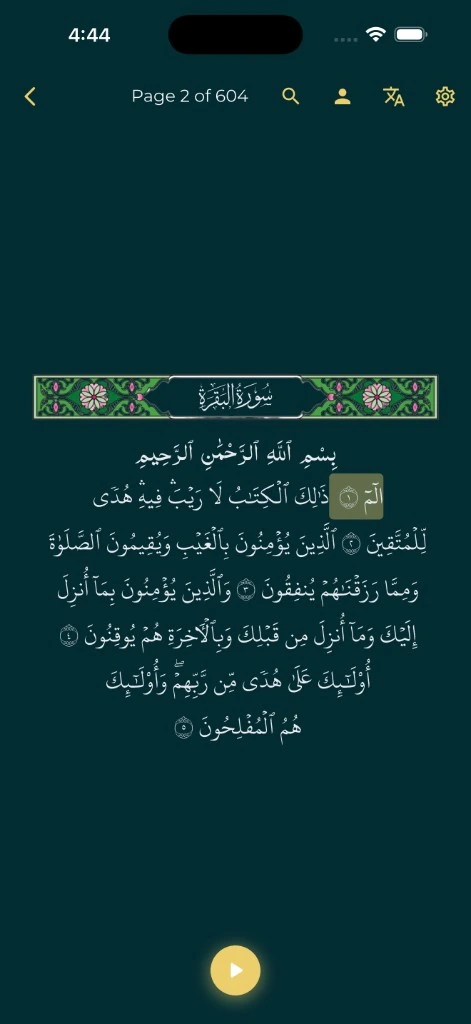
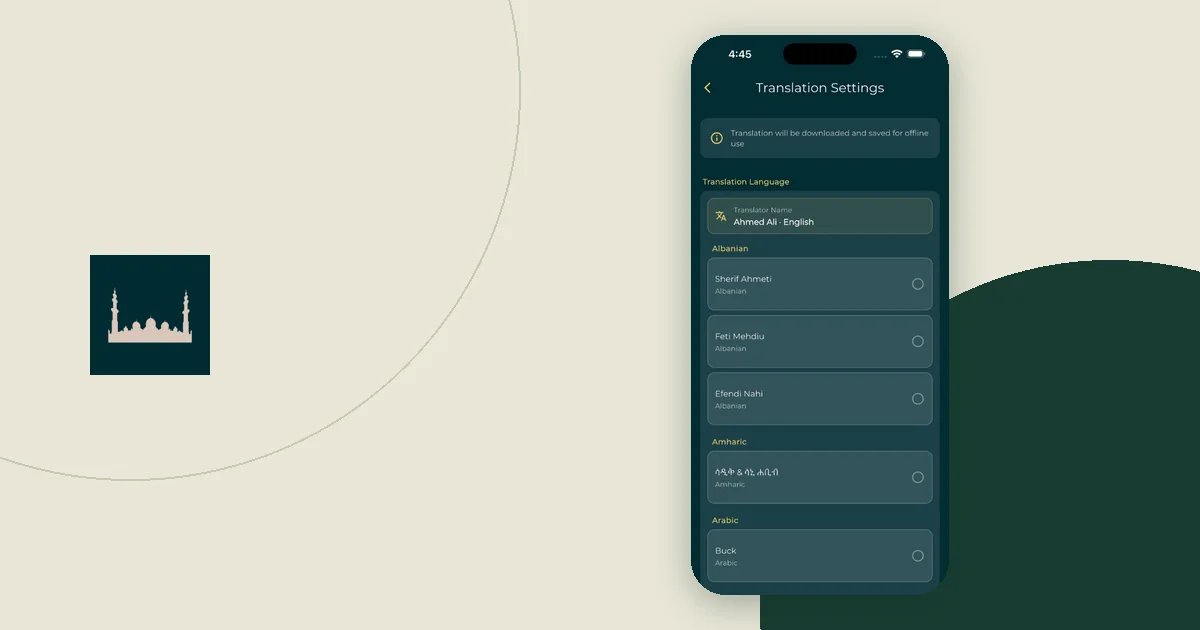
Quran.com names the translator on each verse page. For example, the English shown on Quran 73:4 is credited to Dr. Mustafa Khattab's The Clear Quran. In the Everyday Muslim Quran reader, the translation settings ask you to choose a language and then a translator by name. Whatever app you use, note that name with each saved verse. If the translation text is hard to read, its font size can be changed too; the guide to making an Islamic app easier to read and navigate covers settings like this.
Step 2: Read the passage, not just the line
Read enough of the surrounding text to see what the passage is about. Is it continuing an argument, telling a story, quoting someone or addressing a particular situation? If you cannot tell, make that your question for the session.
Worked example: Quran 107:4 and 107:5. Open Quran 107:4 on Quran.com. In The Clear Quran, the English for this verse ends without any closing punctuation. The sentence carries on into Quran 107:5, which describes the people being spoken about as unmindful of their prayers. Read verse 4 alone and you miss half the sentence. Read both, and the earlier verses of the surah, before you form a view.
This is why a single line shared on social media can mislead. Do not guess the setting of a verse from a caption or a familiar English phrase. Use a tafsir and qualified teaching when the setting or meaning matters.
Quran.com's guide to building a relationship with the Quran describes understanding as coming through Quranic vocabulary, studying a tafsir, even a basic one, and asking knowledgeable teachers. A translation session can lead you toward those sources.
Step 3: Know what each reading aid does
Each layer of a study page does a different job. Keep them labelled, so you always know whose words you are reading.
| Reading aid | What it does | A useful question |
|---|---|---|
| Arabic text | The verse itself | Which exact verse am I studying? |
| Word-by-word gloss | Gives a meaning for each Arabic word | How is this word explained in this context? |
| Translation | Renders the whole verse in another language | How has this translator worded it? |
| Tafsir | Explains the verse within a scholarly tradition | What explanation and sources does this commentator give? |
| Your own note | Records your thoughts | What do I understand, and what still needs checking? |
Word-by-word glosses need care. The Quranic Arabic Corpus FAQ says its English is given purely as a guide to meaning. It also says brackets mark English words that are not explicitly in the Arabic but are implied, such as "of" in a possessive phrase. So not every English word on the screen matches a separate Arabic word.
The Everyday Muslim reader has a Show Word by Word Qur'an setting, with word-by-word translation in English only, and its Tafsir Settings let you select a tafsir edition. Use those as separate layers too. A gloss explains a word; a tafsir explains the verse.
Never blend these layers into one unmarked paragraph. Your reflection should stay clearly yours, not look like a scholar's words.
Step 4: Compare translations on one specific point
When two translations seem to differ, write down the exact word or phrase that made you stop. Read both in context and check any notes before deciding they disagree.
Worked example: Quran 112:1. Open the parallel translations of Quran 112:1 on the Quranic Arabic Corpus. The page lists seven English translators for the same verse. Look at how they differ:
- Sahih International adds the words "[who is]" in square brackets.
- Muhammad Sarwar and Mohsin Khan add words in parentheses naming who is being addressed.
- Pickthall, Yusuf Ali, Shakir and Arberry add no bracketed words.
Now ask one small question: why do some translators add words in brackets? The Corpus FAQ offers a useful comparison: in its own glosses, brackets mark wording that is implied by the Arabic but not written as a separate word. That one question is easier to look into than "Which translation is always right?"
Treat a comparison like this as a reading exercise, not a basis for your own doctrinal conclusion. Bring a real unresolved difference to a teacher who can explain the Arabic and the commentary.
If you are learning Arabic, vocabulary study helps with that conversation. A dictionary entry alone does not decide which meaning applies in a given verse.
Step 5: Keep source notes apart from reflections
Use the same note format each time: verse reference, translator, source checked and your question. The guide to using Quran bookmarks and notes with a clear purpose shows how to keep each passage easy to find again.
Here is the difference in practice:
- Source note: "107:4–5, The Clear Quran. Sentence runs across both verses. Next: read a tafsir on 107:4–5."
- Reflection: "This passage made me think about how I pray when I am rushed."
Both are useful. Keep the reflection marked as yours, so it never reads like an extra instruction from the text.
If your question is about a religious ruling, ask someone qualified and give them the full context. Do not build a personal ruling from one English line or an automated explanation.
Step 6: Share a verse with enough detail to check it
Before sharing a translated verse, check its wording against the named source. Include the surah, the verse number and the translator. If you add a comment, set it apart from the translation.
Check the translation's reuse terms before copying large amounts. A link to the verse is often more useful than a cropped image that loses the reference and translator.
End each session with one next step: continue the passage, read a named tafsir or ask the question you wrote down. A small weekly Islamic learning routine gives those questions a regular place, so you do not have to answer them all alone. A small daily amount with one clear question is often easier to keep than a large target that leaves no time to reflect. The guide to building a small Quran reading habit can help you choose that amount.