Quran & learning
Build a Quran Revision Schedule Before Adding More
List the surahs you have memorized, sort what each needs, and give revision fixed slots in your week before you and your teacher add new material.
Editorial writing date:
To build a Quran revision schedule, list every passage you have memorized, note what each one needs, and give revision fixed slots in your week. Then decide with your teacher how much new material fits in the time that is left.
Revision here means returning to passages you have already memorized, so they stay accurate. You do not have to stop new lessons. You need a clear view of the work already waiting, so new verses do not crowd out the old ones.
Key Takeaways
- List each memorized passage by name and verse range, not as one total.
- Sort problems into four kinds: forgotten words, weak joins, recitation corrections and no time to revise.
- Book revision slots in your week first, then fit new material around them.
- One good recitation does not mean a passage can leave revision.
Step 1: List what you have memorized
Write down each surah or verse range you have memorized. For each one, add the date you last revised it and what happened. If you cannot remember the last check, write "date unknown." Do not guess a reassuring status.
Use labels that point to a next action:
- Needs teacher correction: a sound or stop your teacher is still fixing.
- Needs a recall check: you have not tested it recently.
- In regular revision: recent checks went well; keep returning on a wider gap.
These say what to do next. A label such as "finished" does not.
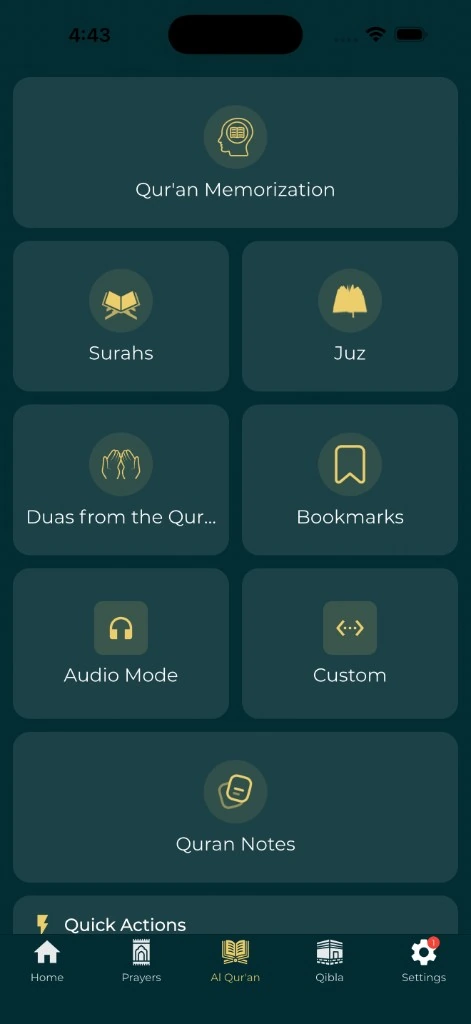
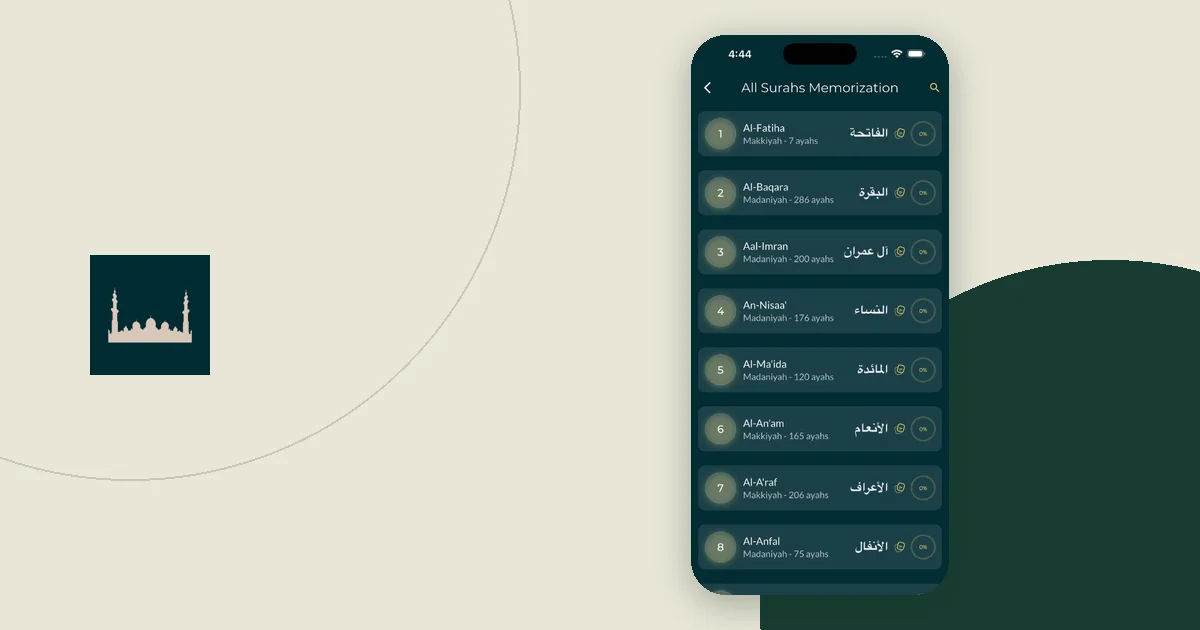
The Everyday Muslim Quran memorization tools keep lists of the ayahs and surahs you mark as memorized. That list is a good starting point for your inventory. It stores which verses you marked, not when you last revised each passage, and it does not test your recitation. The app's Qur'an Goals can hold a Revision goal with a target and an optional reminder, but keep per-passage dates in your own record. A paper sheet works too.
Example: an inventory for four short surahs
Illustration only. This learner and these entries are invented to show the format. The verse counts come from Quran.com's surah pages for An-Nas (6 ayahs), Al-Falaq (5 ayahs), Al-Ikhlas (4 ayahs) and Al-Asr (3 ayahs).
| Passage | Last revised | Status | Next action |
|---|---|---|---|
| Al-Asr 103:1–3 | Last lesson | Needs teacher correction on 103:3 | Teacher listens again at next lesson |
| An-Nas 114:1–6 | Date unknown | Needs a recall check | Recite from memory on Monday |
| Al-Falaq 113:1–5 | Two weeks ago | Hesitated at the join from 113:3 to 113:4 | Practice that join on Wednesday |
| Al-Ikhlas 112:1–4 | Last week | In regular revision | Revise again next week |
Each row now has a task you can start in a few minutes. Before this list, the learner only knew "four surahs memorized."
Step 2: Sort the kinds of difficulty
When a passage feels weak, describe what actually goes wrong. Do you forget the next words? Need a prompt where one verse joins the next? Recognize the words when reading, but lose them from memory? Or is a sound still being corrected?
Each problem needs a different task:
| Problem | Task |
|---|---|
| Forgotten words | Recall check, then practice the missing piece with the text |
| Weak join | Practice the two verses on either side of the join |
| Recitation correction | Listen to the model and have your teacher check you |
| No time to revise | A smaller or better-timed slot in the week |
Checking yourself is a good way to find what needs work. A U.S. Department of Education practice guide on organizing study (Organizing Instruction and Study to Improve Student Learning, 2007) recommends: "use tests and quizzes to identify content that needs to be learned." It labels the evidence for that recommendation "Minimal Evidence." It is a general study tip. It does not replace Quran teaching.
Once you know what each passage needs, the next question is how often to return. The guide to spaced review in a Quran memorization plan covers that timing.
Step 3: Book revision slots before new material
Look at the sessions that really fit your week. Include your lesson, revision on your own and time for corrections. Leave room for normal interruptions. Do not fill every free minute on paper.
Assign your existing passages to those sessions first. Then talk to your teacher about how much new material fits in what remains.
Illustration only. Here is one possible week for a learner with short weekday sessions and a weekend lesson:
| Day | Session | Task |
|---|---|---|
| Monday | Short | Recall check of An-Nas 114:1–6 |
| Tuesday | Short | New verse from the teacher's last lesson |
| Wednesday | Short | Join practice, Al-Falaq 113:3–4 |
| Thursday | Short | New verse, then a quick recall of Al-Ikhlas |
| Friday | None | Rest day |
| Saturday | Lesson | Teacher hears Al-Asr 103:3 and the new verses |
| Sunday | Short | Write next week's plan from the lesson notes |
Only two weekday sessions carry new material. If every weekday were new verses, the older surahs would have no place in the week. Often the fix is to make some sessions revision-only and learn a smaller new piece, rather than promising longer sessions that rarely happen.
Keep your small Quran reading habit apart from this schedule. Reading, learning meaning and revising memorized verses can all fit in a week without sharing one target.
Step 4: Make each revision session easy to start
Give each session one clear first task. "Revise Quran" could mean anything. "Check the join from 113:3 to 113:4" tells you where to begin.
A revision session can follow five steps:
- Open the passage and your correction note.
- Recite from memory, in the way your teacher has agreed.
- Find the exact place that slipped.
- Practice that place with the text, and ask for help if needed.
- Write the next action while it is fresh.
Do not keep guessing at a word you are unsure of. Quran.com's Al-Mulk learning plan says it focuses on memorization and meaning rather than formal tajwid teaching, and it encourages learners to review their recitation with someone knowledgeable. Keep that route to correction in your week. The guide on what a Quran app can and cannot teach about tajwid explains what to check alone and what to save for a lesson.
Keep passages in revision after a good recitation
It is tempting to drop a passage once you recite it well. Research on vocabulary learning gives a reason to wait. In a 2008 study in Science, students learned foreign-language words. After a word was learned, more studying did not help later recall, but more testing did. Students also could not predict how well they would remember.
That study used word lists, not Quran recitation. Still, the practical lesson carries over: keep testing yourself on passages you know, on wider gaps, instead of removing them.
As the memorized portion grows, revising everything each week may stop fitting. One way to handle this is a rotation: older passages are split into parts that take turns across the weeks, while recent or weak passages come round more often. Agree the rotation and its size with your teacher, and write each passage's next turn in your inventory.
Spacing research also shows there is no single right gap. Cepeda and colleagues found that the best review gap depended on how long the facts had to be remembered. Use that as a reason to adjust gaps with your teacher, not as a rule for how many days to wait.
Restart after a gap
After time away, start from your inventory. Do not try to make up every missed session at once. Pick one or two passages, check them, and let the result shape the next lesson. A long break may call for different priorities than one busy day.
Ask your teacher whether older passages are getting enough time before the new lesson grows. Update the inventory, so the plan reflects where you are now.
Let new material fit the revision you can keep
When there is room to add more, keep the new piece small enough that its future revision also fits your week. Every new passage becomes a passage you will revise.
A good revision schedule helps you arrive at lessons ready, remember your corrections and pick the next task quickly. For more on goals that support learning instead of scores, see setting worship goals without turning them into scores.