Quran & learning
What a Quran App Can and Cannot Teach About Tajwid
A Quran app can play a model recitation, repeat verses and pause for you. App feedback does not replace a qualified teacher who checks your tajwid.
Editorial writing date:
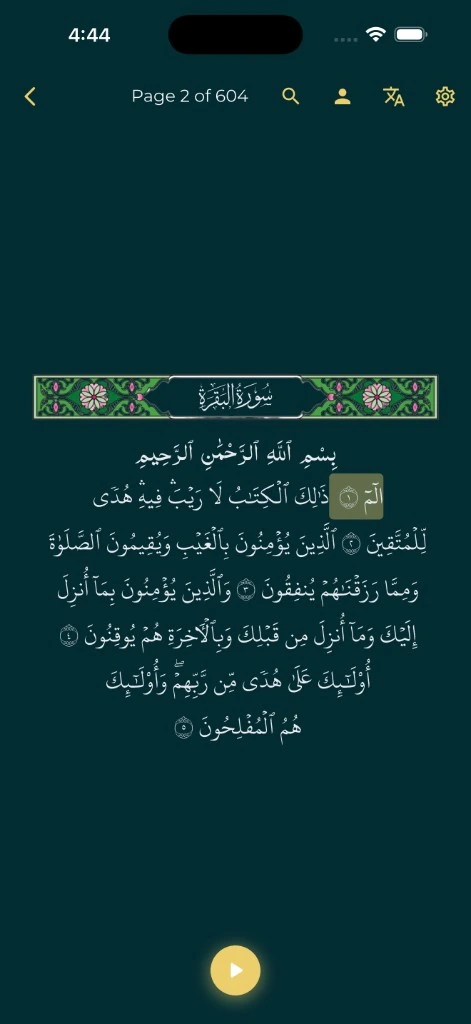
A Quran app can play a model recitation, repeat a verse (ayah) as often as you need and keep the text in front of you. The sources below treat checking your own recitation as a teacher's job, so app feedback does not replace a teacher's check. For tajwid, the app helps you practice, and a qualified teacher listens to you, names the correction and checks it at the next lesson.
Tajwid is about how the Quran is recited: how each letter is pronounced and how sounds join. Knowing a rule and producing the sound are different skills. A teacher's ear connects the two.
Key Takeaways
- Use the app to hear a model, repeat a verse and keep the text open.
- Hearing a correct recitation is not the same as having your own recitation checked.
- Write each correction with its verse reference, and practice only that point.
- Ask before recording anyone, and check where a recording will be stored.
What the app can do, and what needs a teacher
| Task | Can a Quran app help? | Who checks it? |
|---|---|---|
| Show the Arabic text of the verse | Yes | You |
| Play a model recitation | Yes | Your teacher chooses the reciter |
| Repeat one verse or a range | Yes | You |
| Add a pause so you can recite between verses | Yes, in some apps | You |
| Keep your correction note | Yes, or use paper | You |
| Hear whether your sound is correct | Not in place of a teacher | Your teacher |
| Explain how to change your sound | Not in place of a teacher | Your teacher |
| Decide when a passage is ready | No | Your teacher |
If an app offers automatic recitation feedback, read exactly what it claims to detect, and ask your teacher whether to rely on it. A 2025 preprint review of automated Quranic recitation assessment by Al-Kharusi and colleagues found that such systems "have struggled to gain broad acceptance or demonstrate educational effectiveness." It adds that many focus on identifying words rather than judging how each sound is produced.
Practice controls to look for
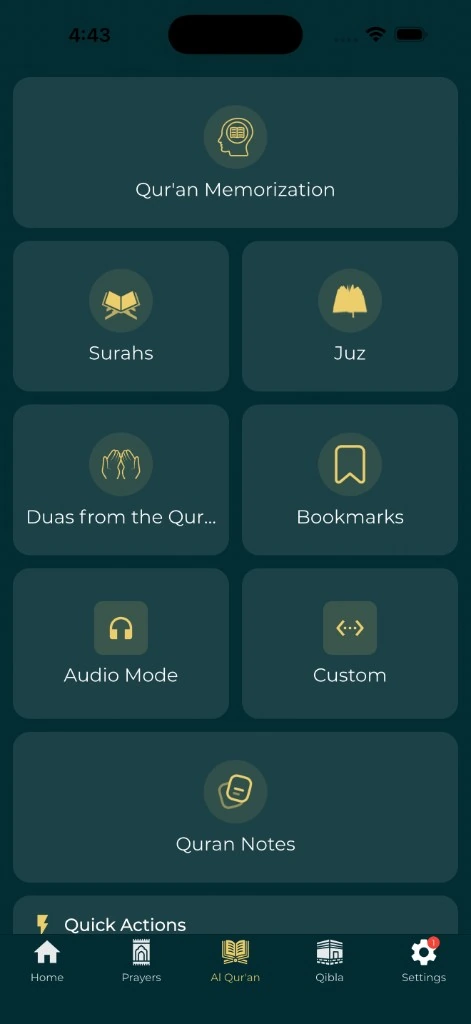
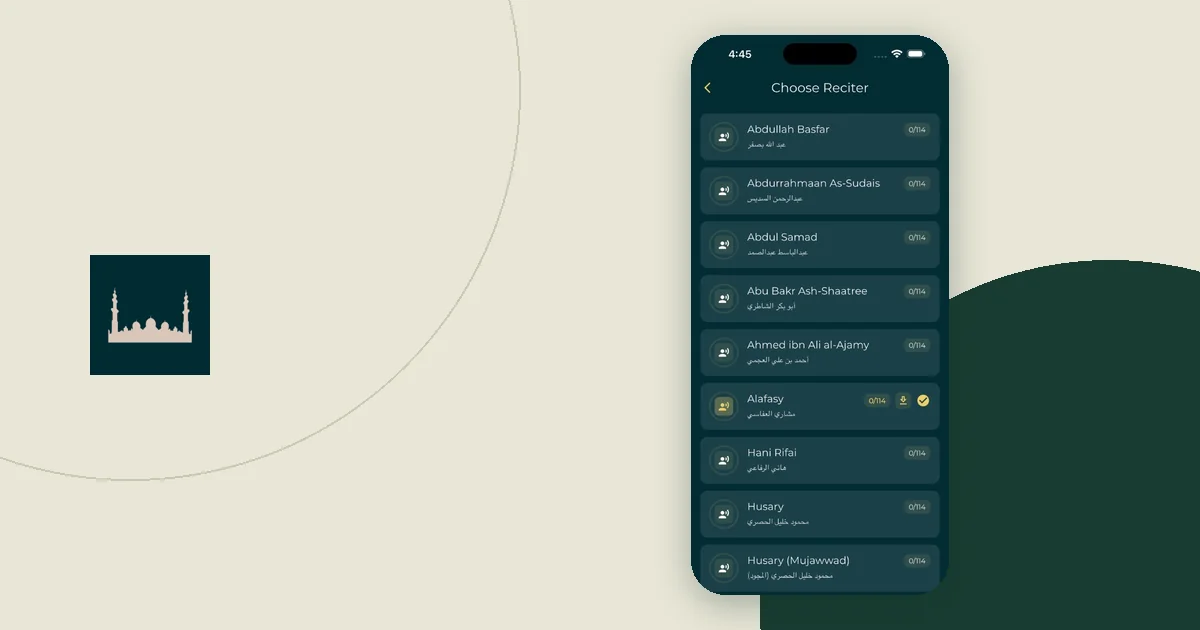
Look for a choice of reciter, a repeat count for each verse, range or surah repeat, and a pause between verses. As one example, the Everyday Muslim Quran reader lets you choose a reciter and download audio for offline use. Its settings can show the Quran word by word with transliteration, and the word-by-word translation is English only. Its playback settings, shared with the Quran memorization tools, set how many times each ayah repeats and add a delay between ayahs: none, 3, 5 or 10 seconds, or a pause as long as the ayah itself. That pause gives you time to recite the verse after the model.
The app does not assess your recitation. Its memorization records show what you marked as memorized, not a tajwid test. Treat transliteration as a reading aid only; your teacher can show where Latin spelling falls short.
Why tajwid needs a teacher
Listening gives you a model. It does not prove that your sound matches it, or show you how to change it.
Quran 73:4 includes the instruction to recite the Quran in a measured way. Quran.com's guide to building a relationship with the Quran goes further, saying learners should find a qualified teacher to teach them to recite with tajwid.
Cambridge Muslim Academy's recitation course requires students to complete its theoretical tajwid curriculum. For non-Arabic speakers, its certificate also requires recitation under the supervision of a qualified and accredited instructor. This is one example of how teaching is organized, not a course recommendation.
Quran.com's Al-Mulk learning plan also encourages learners to review their recitation with someone knowledgeable.
What a qualified teacher means in practice
AboutIslam's introduction to tajwid (Muhammad Fathi, 2025) describes the traditional way recitation is taught. The student recites to a certified teacher, who may grant a licence called an ijazah. A typical ijazah lists the teacher's own teachers, a chain (sanad) that goes back to the Prophet ﷺ.
You do not need to judge a chain yourself. Ask plain questions when you look for a teacher:
- How did you learn to recite, and with whom?
- Whose recitation checked yours? Do you hold an ijazah, and for which recitation and portion?
- How do you correct a mistake, and how will you check it next time?
A class at your local masjid or Islamic centre lets a teacher hear you in person. An online teacher on a live video call can do the same if there is no class nearby. If you cannot keep a regular teacher, arrange a periodic live check-in and keep your correction notes between sessions.
In each lesson, ask what to listen for in the verse and what exactly to change.
Example: one correction through one week
Illustration only. This note is invented to show the process. The correction is a placeholder, because only a teacher who has heard you can write it. A short note for one verse is easier to use than a long list of "tajwid mistakes":
| Field | Entry |
|---|---|
| Verse | Al-Falaq 113:1 |
| Teacher's correction | [the teacher's words, written down in the lesson] |
| Model | The reciter the teacher chose, verse 113:1 on repeat |
| Practice plan | Five minutes a day, this verse only |
| Open question | [anything still unclear, without guessing an answer] |
| Next check | Teacher listens at next Saturday's lesson |
The week then follows the same loop each day:
- Open 113:1 in the text.
- Play the model with a pause after the verse.
- Recite in the pause, focusing only on the corrected point.
- Write down anything still unclear. Do not invent an answer.
- Let the teacher check your attempt at the next lesson.
The guide to using Quran bookmarks and notes with a clear purpose shows how to keep references easy to reopen. For a calm session setup, see pairing Quran listening with a reading session.
Be careful with recordings
If a recording would help your teacher, ask how they want to receive it. Check whether the platform stores or shares it, and send only the verses needed.
Ask before recording anyone else, including your teacher or another student. For a child, follow your family's rules and the teaching provider's safeguarding policy. The guide to reading a Muslim app privacy policy can help you check where audio goes.
A live lesson gives feedback without keeping a recording at all.
Judge progress in the lesson, not on the screen
A finished lesson, a streak or an automatic score shows what the app recorded. It may count activity without telling you whether your correction has been fixed.
If you are also memorizing, carry each correction into your Quran revision schedule. Let your teacher decide when a passage is ready to move on.
Use the app to make the next practice step clear and the model recitation easy to reach. Keep the judgment of your recitation with someone who can hear you.