Prayer & daily life
True North and Magnetic North in a Qibla App
How true north, magnetic north and declination affect a Qibla bearing, with a worked New York example and checks for iPhone and Android phone headings.
Editorial writing date:
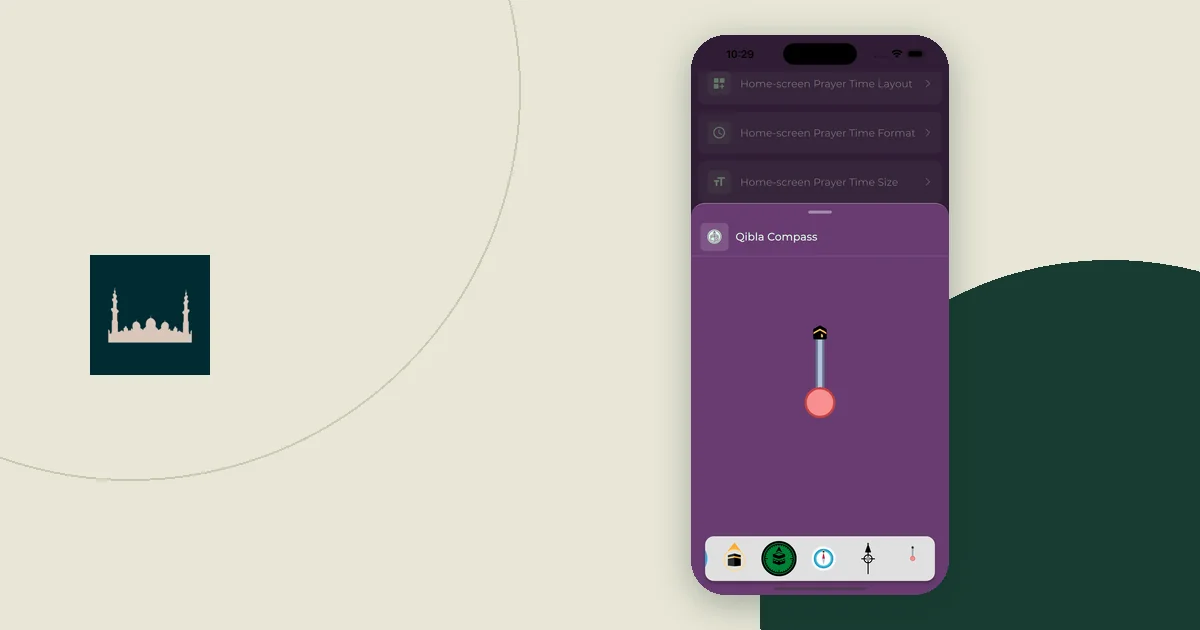
A Qibla bearing is usually measured from true north. A phone or pocket compass usually points to magnetic north. The angle between them is called magnetic declination, and it depends on where you are and the year. Before you compare two numbers, find out which north each one uses. Then correct only the one that needs it.
Key Takeaways
- True north points to the geographic North Pole. Magnetic north is where a compass needle points.
- To turn a true bearing into a magnetic one, subtract the signed declination. East declination is positive; west is negative.
- In New York in November 2026, a 58.5° true Qibla bearing is about 71° on a magnetic compass.
- Declination converts between references. It does not fix a phone heading that drifts or jumps.
Four numbers, four names
The word "direction" can hide several different measurements. Name each one before you change anything.
| Term | What it means | Question to ask |
|---|---|---|
| True north | The geographic north reference used by maps | Is the Qibla bearing measured from here? |
| Magnetic north | The direction a compass needle points at your location | Does the phone heading use this? |
| Qibla bearing | The calculated direction toward the Kaaba from a place | Which place and which north were used? |
| Phone heading | The direction the top edge of your phone is facing | Is it steady, and which north does it use? |
USGS explains that at most places a compass does not point exactly to geographic north, and that the difference varies with location and time. So a map bearing and a compass reading can differ without either being wrong.
Where each number comes from
The Qibla bearing comes from coordinates. The Adhan Qibla source code uses your latitude and longitude and the Kaaba's coordinates in a spherical calculation. It never reads a phone sensor. The Qibla finder on this site uses that library and labels every result as clockwise from true north.
The phone heading comes from sensors, and both major platforms describe it against magnetic north:
- iPhone: Apple documents the heading that Safari gives web pages, webkitCompassHeading, as measured "relative to magnetic north." When the Qibla finder receives it, the status line says: "Your sensor uses magnetic heading; the calculated bearing uses true north."
- Android: Android's position-sensor guide defines the azimuth as the angle between the device's compass direction and magnetic north.
A single app may still convert the heading to true north before it draws the arrow. Check its help pages or labels. If it says "true heading," do not correct it again.
Convert with the sign
NOAA's declination guide sets the rule: declination is positive east of true north and negative west of it. You get a true bearing by adding the declination to a magnetic bearing. Turned around:
- True to magnetic: magnetic bearing = true bearing − declination
- Magnetic to true: true bearing = magnetic bearing + declination
The sign is where most mistakes happen. Write it down with the number.
Worked example: New York in November 2026
This is an illustration for central New York (40.7128, −74.0060) on 5 November 2026. Your position and date will give different values.
- Qibla bearing: this site's engine gives 58.5° from true north, roughly east-northeast. The New York Qibla page shows the same figure.
- Declination: the British Geological Survey's World Magnetic Model service (WMM2025) gives −12.5°, meaning 12.5° west.
- Magnetic bearing: 58.5 − (−12.5) = 71.0°.
- Check: NOAA's rule says magnetic + declination = true, and 71.0 + (−12.5) = 58.5. The numbers agree.
So on a plain magnetic compass in central New York, the Qibla is about 71°, not 58.5°. If you skipped the conversion, you would face about 12° too far north. If you applied it twice, you would be about 12° off the other way.
The same check in other cities
The size of the correction changes a lot from place to place. These figures use city-center coordinates, this site's Qibla engine and the same BGS model service for 5 November 2026. They are illustrations, not values for your street.
| City | Qibla bearing (true) | Declination | Magnetic bearing |
|---|---|---|---|
| London | 119.0° | +1.2° (east) | 117.8° |
| New York | 58.5° | −12.5° (west) | 71.0° |
| Toronto | 54.6° | −10.1° (west) | 64.7° |
| Istanbul | 151.6° | +6.1° (east) | 145.5° |
| Sydney | 277.5° | +12.8° (east) | 264.7° |
In London the two references are only about one degree apart. In New York, Toronto and Sydney the gap is more than ten degrees, so the label matters.
Declination also drifts over time. The BGS model result for central London shows it moving east by about 10 arcminutes a year, roughly a sixth of a degree. Do not reuse a correction from an old trip or an old map.
A drifting arrow is a different problem
A steady offset and an arrow that moves while the phone is still need different checks.
| What you see | First check |
|---|---|
| Two tools give different bearings | Match the place each one uses |
| Bearings agree, but the arrows differ by a steady amount | Find each heading's north reference |
| The arrow shifts when you move the phone to another surface | Check for metal or magnets nearby |
| The arrow stays fixed when you turn the phone | Check that the phone compass is switched on |
| No usable heading appears | Use the true bearing with a north-up map |
Do not use declination as a dial to turn until two arrows line up. That hides the real problem. The four-step Qibla compass check walks through sensor problems in order.
Make a direction note you can reuse
For a room you will use more than once, write down:
- The place used for the calculation
- The Qibla bearing with its reference, for example "58.5° from true north"
- How you found north: a north-up map, a marked direction, or a compass (and whether it was adjusted for declination)
- The declination value and date, if you converted
"58.5°" on its own is not enough. "58.5° from true north, about 71° magnetic, November 2026" tells you exactly what to do next time.
If you would rather not grant location access, start from a city or typed coordinates instead; the guide to finding Qibla without sharing your precise location shows how. You still need a sound north reference afterward.
These notes describe geography and phone behavior. Questions about a particular prayer or an uncertain situation belong with a qualified teacher who knows the details.