Prayer & daily life
Prayer Time Settings for Long Summer Days
See why long summer days complicate Fajr and Isha, what high-latitude rules do, and how three rules compare for Oslo in June, with questions to ask.
Editorial writing date:
Far from the equator in summer, the Sun may never sink far enough below the horizon for the usual Fajr and Isha calculation to work. Prayer apps then use a high-latitude rule to set those two times instead. Different rules can give results more than an hour apart. Start with the rule your local timetable uses, then check that your app can apply it.
Which rule a northern or southern community should follow is a religious question for its scholars and mosques. Not every app exposes the same settings either.
Key Takeaways
- A calculation method sets Fajr and Isha by a twilight angle. A high-latitude rule takes over when that angle is out of reach or gives impractical times.
- In the Oslo example for 21 June 2027, three rules put Fajr anywhere from 1:19 AM to 3:09 AM.
- Rule names can mean slightly different things in different libraries. Check what your app's control does.
- Ask your local mosque which rule it uses, and compare several dates rather than adding a fixed offset.
Why the usual calculation breaks down
Most calculation methods set Fajr and Isha by a twilight angle. That is how far the Sun sits below the horizon when the method says Fajr begins or Isha begins. The Muslim World League method, for example, uses 18° for Fajr and 17° for Isha, according to Adhan's calculation methods guide.
The Royal Observatory Greenwich describes 18° below the horizon as the point where it is truly dark, with no afterglow left. The US Naval Observatory uses the same 18° figure for the end of astronomical twilight.
Here is the problem. On a midsummer night far north, the Sun dips only a little way below the horizon. For Oslo (about 59.9° N) on 21 June, a simple geometric estimate puts the Sun's lowest point at only about 6.6° below the horizon. That is our own rough calculation (90° minus the latitude minus the Sun's 23.4° tilt), ignoring the bending of light near the horizon. Either way, the Sun never gets near 17° or 18°. So the angle-based Fajr and Isha simply do not occur that night.
The USNO adds a second caution: at high latitudes, sunrise and sunset calculations themselves become less accurate, because small changes in the atmosphere, the observer's height and the local landscape have a bigger effect.
What the three common high-latitude rules do
A high-latitude rule sets Fajr and Isha from the length of the night instead, measured from sunset to sunrise. The PrayTimes calculation reference and the Adhan guide describe three common rules:
| High-latitude rule | Plain description |
|---|---|
| Middle of the night | Uses the midpoint between sunset and sunrise as the limit for both Isha and Fajr |
| One-seventh of the night | Isha no later than the end of the first seventh of the night; Fajr no earlier than the start of the last seventh |
| Twilight angle | Splits the night in proportion to the angle: for an 18° Fajr, Fajr starts 18/60 (about 0.3) of the night before sunrise |
There is a subtle difference between libraries. PrayTimes describes its middle-of-the-night method as placing Fajr and Isha at midnight during abnormal periods. Adhan describes its rule as a limit: Fajr "will never be earlier than the middle of the night". The names match, but the wording does not, so check what your own app's control does.
Adhan also recommends the one-seventh rule for locations above 48° latitude.
Worked example: Oslo on 21 June 2027
Illustration only, not a timetable to follow. We used the Adhan 4.4.6 library bundled with this site for Oslo, Norway (59.9139° N, 10.7522° E, Europe/Oslo zone), with the Muslim World League method (Fajr 18°, Isha 17°). Only the high-latitude rule changed between columns.
| Prayer | Middle of the night | One-seventh of the night | Twilight angle |
|---|---|---|---|
| Maghrib (sunset) | 10:44 PM | 10:44 PM | 10:44 PM |
| Isha | 1:19 AM | 11:28 PM | 12:12 AM |
| Fajr | 1:19 AM | 3:09 AM | 2:21 AM |
| Sunrise | 3:54 AM | 3:54 AM | 3:54 AM |
The night lasts 5 hours 10 minutes, from 10:44 PM to 3:54 AM. Under the middle-of-the-night rule, Isha and Fajr both fall at its midpoint, 1:19 AM. Under the one-seventh rule, each seventh is about 44 minutes, so Isha is 44 minutes after sunset and Fajr 45 minutes before sunrise. The twilight-angle rule falls in between.
That is a 110-minute spread for Fajr on a single night, from three documented rules. None of them is a software fault. They are different answers to a question the twilight angle cannot answer on that date.
One further result is worth knowing. We ran the same comparison for Oslo on 21 December 2027. With one-seventh of the night, Fajr came out at 6:43 AM, while the other two rules gave 6:32 AM. In Adhan, the one-seventh limit can still apply in winter whenever the angle-based time falls outside its bound. So a high-latitude rule is not only a "summer setting".
What the online tool and the app do
The online prayer-time tool does not offer a separate high-latitude control. It applies Adhan's recommended rule for the location, which is one-seventh of the night above 48° latitude, and marks a time as unavailable when it cannot be calculated. For Oslo on the June date above, that means the one-seventh column.
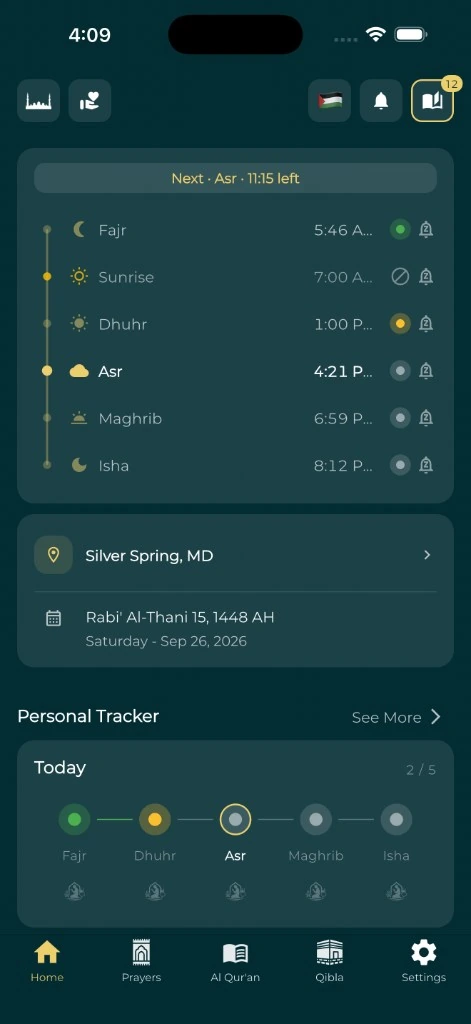
The Everyday Muslim app's calculation settings include a High Latitude Adjustment control with middle of the night, 1/7 of the night and twilight angle options. Do not assume every app has the same control, or that a library feature you read about exists in an older installed version.
A separate problem arises inside the polar circles, where on some dates the Sun does not set or does not rise at all. A night-based rule needs a sunset and a sunrise to work from. The Adhan guide documents "polar circle resolution" separately for that case, for example by borrowing times from the nearest date or place where sunrise and sunset can be calculated.
Ask how the local timetable is produced
Ask the mosque or organization that publishes your timetable about its method, its seasonal policy and its columns. Ask for start times separately from congregation times if both are listed.
A short set of questions keeps the conversation precise:
- Which calculation method and which high-latitude rule do you use for Fajr and Isha in summer?
- Does the rule change at a certain point in the year?
- Is it a named preset, a documented calculation or a published timetable only?
- Are there any local adjustments on top of the calculation?
- Who can explain how it applies to my own circumstances?
Save the answer or the timetable's public explanation. A named rule is easier to keep than "the one that matched a screenshot". If two sources disagree, ask each to explain its approach rather than averaging the times.
Compare several dates with the same inputs
Check the period your routine has to cover. Compare a date before the hardest weeks, one in the middle and one after, using the same place and settings.
| Question | Why it matters |
|---|---|
| Do sunrise and sunset occur normally on this date? | Night-based rules need both to work |
| Which calculation method is selected? | It sets the twilight angles |
| Which high-latitude rule is selected? | It decides Fajr and Isha when the angle fails |
| Is polar handling documented? | Dates without a sunset or sunrise need another approach |
This is an inspection plan, not a scientific test of the calculation. Look for unexplained changes, missing results and differences from the timetable you follow.
If a single day's gap disappears when you add a fixed adjustment, do not assume that adjustment fixes the season. The Oslo example shows rules drifting apart by different amounts on different dates. The broader guide to differences between prayer apps helps keep method, date, time-zone and rounding questions apart.
Build your routine around a checked schedule
Once the rule is clear, look at your reminders. A notification that suited a winter timetable may not fit a short summer night. The guide to prayer reminders you will actually notice can help you adjust them, and the evening plan for waking up for Fajr covers the night before an early Fajr.
If your working hours also change, the shift-work salah planning guide can help you organize breaks around the confirmed times. Questions about sleep, work and your own religious situation belong with people qualified to advise on them.
If you contact the app's support team, give the city, the dates, the app version, the calculation method and the high-latitude rule, plus a description of what looked wrong. Include the local timetable's explanation if there is one. Ask whether the app supports that documented approach, and how it shows a time it cannot calculate.