
Everyday Muslim · Daily duas
Daily duas, ready when you need them.
Read from the Hisnul Muslim collection, listen where audio is available, and keep the duas you return to in one place. Everyday Muslim brings Arabic, translation and transliteration together in its free dua app.
- Hisnul Muslim collection
- Folders & personal notes
- Arabic & translation
Reference
Everyday duas with Arabic, transliteration and meaning
These are fifteen short duas for everyday moments, from waking up to leaving the house, eating, visiting the masjid and travelling. Each one gives the Arabic as printed in its source, a transliteration, an English meaning and the exact Quran or hadith reference so you can look it up yourself.
Transliteration only approximates Arabic sounds and English meanings are not the original words, so check your pronunciation and wording with a qualified teacher. The Everyday Muslim app holds a larger dua collection with audio where available.
| When | Arabic | Transliteration | Meaning | Source |
|---|---|---|---|---|
| Waking up | الْحَمْدُ لِلَّهِ الَّذِي أَحْيَانَا بَعْدَ مَا أَمَاتَنَا وَإِلَيْهِ النُّشُورُ | Al-ḥamdu lillāhil-ladhī aḥyānā baʿda mā amātanā wa ilayhin-nushūr | All praise is for Allah, who gave us life after He had caused us to die, and to Him is the rising. | Sahih al-Bukhari 6312 |
| Before sleep | بِاسْمِكَ أَمُوتُ وَأَحْيَا | Bismika amūtu wa aḥyā | In Your name I die and I live. | Sahih al-Bukhari 6312 |
| Leaving the home | بِسْمِ اللَّهِ تَوَكَّلْتُ عَلَى اللَّهِ لاَ حَوْلَ وَلاَ قُوَّةَ إِلاَّ بِاللَّهِ | Bismillāh, tawakkaltu ʿalallāh, lā ḥawla wa lā quwwata illā billāh | In the name of Allah; I place my trust in Allah; there is no might and no power except with Allah. | Sunan Abi Dawud 5095 (graded sahih by al-Albani on Sunnah.com) |
| Before eating | بِسْمِ اللَّهِ | Bismillāh | In the name of Allah. The hadith instructs: “Mention the name of Allah (سَمِّ اللَّهَ) and eat with your right hand.” | Sahih al-Bukhari 5376; wording بِسْمِ اللَّهِ as in Sunan Abi Dawud 3767 |
| After eating | الْحَمْدُ لِلَّهِ كَثِيرًا طَيِّبًا مُبَارَكًا فِيهِ، غَيْرَ مَكْفِيٍّ، وَلاَ مُوَدَّعٍ وَلاَ مُسْتَغْنًى عَنْهُ، رَبَّنَا | Al-ḥamdu lillāhi kathīran ṭayyiban mubārakan fīh, ghayra makfiyyin wa lā muwaddaʿin wa lā mustaghnan ʿanhu, Rabbanā | All praise is for Allah, abundant, good and blessed praise, praise that is never enough, never abandoned and never done without, our Lord. | Sahih al-Bukhari 5458 |
| Entering the masjid | اللَّهُمَّ افْتَحْ لِي أَبْوَابَ رَحْمَتِكَ | Allāhumma-ftaḥ lī abwāba raḥmatik | O Allah, open for me the doors of Your mercy. | Sahih Muslim 713a |
| Leaving the masjid | اللَّهُمَّ إِنِّي أَسْأَلُكَ مِنْ فَضْلِكَ | Allāhumma innī asʾaluka min faḍlik | O Allah, I ask You of Your bounty. | Sahih Muslim 713a |
| Entering the restroom | اللَّهُمَّ إِنِّي أَعُوذُ بِكَ مِنَ الْخُبُثِ وَالْخَبَائِثِ | Allāhumma innī aʿūdhu bika minal-khubuthi wal-khabāʾith | O Allah, I seek refuge with You from evil and from evil things. | Sahih al-Bukhari 142 |
| Leaving the restroom | غُفْرَانَكَ | Ghufrānak | (I ask) Your forgiveness. | Sunan Abi Dawud 30 (graded sahih by al-Albani on Sunnah.com); Jami` at-Tirmidhi 7 |
| Setting out on a journey | سُبْحَانَ الَّذِي سَخَّرَ لَنَا هَذَا وَمَا كُنَّا لَهُ مُقْرِنِينَ وَإِنَّا إِلَى رَبِّنَا لَمُنْقَلِبُونَ | Subḥānal-ladhī sakhkhara lanā hādhā wa mā kunnā lahū muqrinīn, wa innā ilā Rabbinā lamunqalibūn | Glory be to the One who has subjected this to us, and we could not have done so ourselves, and to our Lord we will surely return. | Sahih Muslim 1342 (opening of a longer supplication, said after saying Allāhu akbar three times); the words are also Quran 43:13–14 |
| Distress | لاَ إِلَهَ إِلاَّ اللَّهُ الْعَظِيمُ الْحَلِيمُ، لاَ إِلَهَ إِلاَّ اللَّهُ رَبُّ الْعَرْشِ الْعَظِيمِ، لاَ إِلَهَ إِلاَّ اللَّهُ رَبُّ السَّمَوَاتِ، وَرَبُّ الأَرْضِ، وَرَبُّ الْعَرْشِ الْكَرِيمِ | Lā ilāha illallāhul-ʿAẓīmul-Ḥalīm, lā ilāha illallāhu Rabbul-ʿarshil-ʿaẓīm, lā ilāha illallāhu Rabbus-samāwāti wa Rabbul-arḍi wa Rabbul-ʿarshil-karīm | There is no god but Allah, the Magnificent, the Forbearing. There is no god but Allah, Lord of the Mighty Throne. There is no god but Allah, Lord of the heavens, Lord of the earth and Lord of the Noble Throne. | Sahih al-Bukhari 6346 |
| Worry and grief | اللَّهُمَّ إِنِّي أَعُوذُ بِكَ مِنَ الْهَمِّ وَالْحَزَنِ، وَالْعَجْزِ وَالْكَسَلِ، وَالْجُبْنِ وَالْبُخْلِ، وَضَلَعِ الدَّيْنِ، وَغَلَبَةِ الرِّجَالِ | Allāhumma innī aʿūdhu bika minal-hammi wal-ḥazan, wal-ʿajzi wal-kasal, wal-jubni wal-bukhl, wa ḍalaʿid-dayn, wa ghalabatir-rijāl | O Allah, I seek refuge with You from worry and grief, from incapacity and laziness, from cowardice and miserliness, from the burden of debt and from being overpowered by others. | Sahih al-Bukhari 6369 |
| For parents | رَّبِّ ٱرْحَمْهُمَا كَمَا رَبَّيَانِى صَغِيرًا | Rabbir-ḥamhumā kamā rabbayānī ṣaghīrā | My Lord, have mercy on them as they brought me up when I was small. | Quran 17:24 |
| For knowledge | رَّبِّ زِدْنِى عِلْمًا | Rabbi zidnī ʿilmā | My Lord, increase me in knowledge. | Quran 20:114 |
| Good in this life and the next (Rabbana atina) | رَبَّنَآ ءَاتِنَا فِى ٱلدُّنْيَا حَسَنَةً وَفِى ٱلْـَٔاخِرَةِ حَسَنَةً وَقِنَا عَذَابَ ٱلنَّارِ | Rabbanā ātinā fid-dunyā ḥasanatan wa fil-ākhirati ḥasanatan wa qinā ʿadhāban-nār | Our Lord, give us good in this world and good in the Hereafter, and protect us from the punishment of the Fire. | Quran 2:201 |
Hadith references use Sunnah.com numbering. Gradings are shown only where Sunnah.com displays one for that narration; the Bukhari and Muslim entries are from those two Sahih collections.
Quran rows quote only the words of supplication from a longer verse. In Quran 17:24 the words are taught as part of the command to honour parents, and in Quran 20:114 they are addressed to the Prophet ﷺ; read the full verse for context.
If you forget to say Bismillah at the start of a meal, Sunan Abi Dawud 3767 gives the words بِسْمِ اللَّهِ أَوَّلَهُ وَآخِرَهُ (Bismillāhi awwalahū wa ākhirah), “In the name of Allah at its beginning and at its end.”
Sahih Muslim 2018 mentions remembering Allah when entering the home, but does not give a fixed wording, so no entering-the-home text is listed here.
The travel dua in Sahih Muslim 1342 continues with further supplications for the journey; the table shows only its opening.
Find the dua for the moment
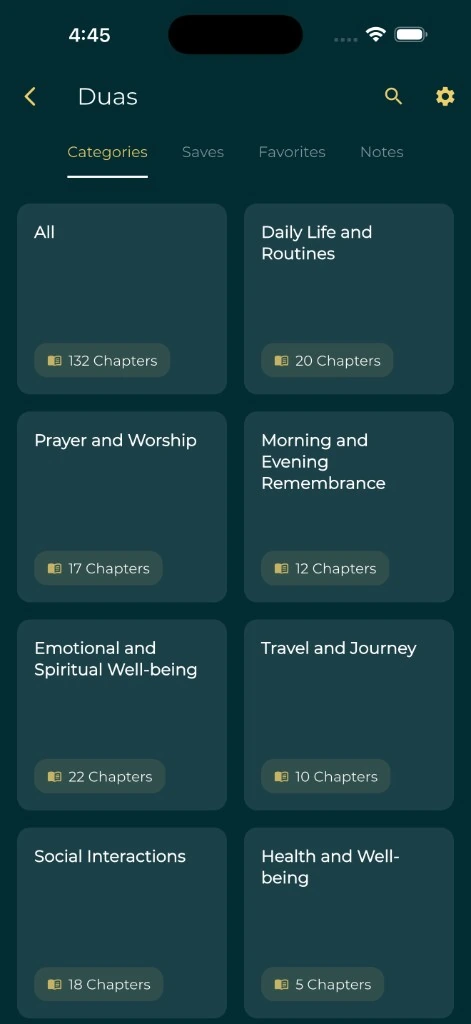
Browse the collection by chapter and category rather than keeping a long list of screenshots. Open a dua to read its Arabic text, translation, transliteration and source information where provided. The last-read shortcut helps you return to your place.
For a morning routine, bedtime or another recurring moment, save a small selection you can find easily. The website introduces the feature; the full dua collection is in the mobile app.
Read and listen at your own pace
Adjust the Arabic, translation, transliteration and source display in Dua Settings. Separate font and size controls let you make the text comfortable to read without giving each part the same size.
Use the audio control when a recording is available. Audio may need an internet connection; this page does not promise a recording or an offline download for every dua. Transliteration can help you get started, while listening and learning with a teacher support pronunciation.
Make room for the duas you return to
Mark favorites, organize saved duas into folders and add notes for your own reference. You can also create a custom dua with its own title and text. Your personal entries stay distinct from the built-in collection.
A folder can be as simple as the duas you want to learn this week. Keep notes short enough to be useful when you open them again, and use the source details in the collection when you want to learn more.
Connect reading with remembrance
Use the tasbih counter when you want help keeping a count, or create an Islamic card from supported dua content to share a reminder. Choose what you share and review the finished card before sending it.
Try the online dhikr counterA few useful answers
Before you begin.
Does Everyday Muslim include Hisnul Muslim duas?
Yes. The mobile app includes the Hisnul Muslim dua collection with reading and organization tools.
Can I read Arabic with English translation and transliteration?
Yes. The app provides separate display and font settings for Arabic, translation, transliteration and source text.
Can I add my own duas?
Yes. Create custom duas and organize saved entries in folders. Personal entries are not presented as additions to the sourced built-in collection.
Are all dua recordings available offline?
This page does not promise offline audio for every dua. Use the available audio controls in the current app; playback can require a connection.
Where do these duas come from?
Each dua is quoted from the Quran or from a hadith collection: Sahih al-Bukhari, Sahih Muslim, Sunan Abi Dawud or Jami` at-Tirmidhi. The Source column gives the exact reference so you can open it on Quran.com or Sunnah.com.
Is the transliteration enough to learn a dua?
Transliteration is a starting point. It cannot show every Arabic sound exactly, so listen to recitation and check your pronunciation with a qualified teacher.
Why does the Arabic look slightly different between Quran and hadith rows?
Quran rows use the Uthmani script shown on Quran.com, which has some extra marks and spellings. Hadith rows use the Arabic text shown on Sunnah.com.
Sources & further reading
- Sahih al-Bukhari 6312 (Sunnah.com)
- Sunan Abi Dawud 5095 (Sunnah.com)
- Sahih al-Bukhari 5376 (Sunnah.com)
- Sunan Abi Dawud 3767 (Sunnah.com)
- Sahih al-Bukhari 5458 (Sunnah.com)
- Sahih Muslim 713a (Sunnah.com)
- Sahih al-Bukhari 142 (Sunnah.com)
- Sunan Abi Dawud 30 (Sunnah.com)
- Jami` at-Tirmidhi 7 (Sunnah.com)
- Sahih Muslim 1342 (Sunnah.com)
- Sahih Muslim 2018a (Sunnah.com)
- Sahih al-Bukhari 6346 (Sunnah.com)
- Sahih al-Bukhari 6369 (Sunnah.com)
- Quran 43:13 (Quran.com)
- Quran 43:14 (Quran.com)
- Quran 17:24 (Quran.com)
- Quran 20:114 (Quran.com)
- Quran 2:201 (Quran.com)
Made by Muslims. For Muslims.
Keep your essentials close.
Prayer times, Quran, Qibla and worship trackers. Free and ad-free.